
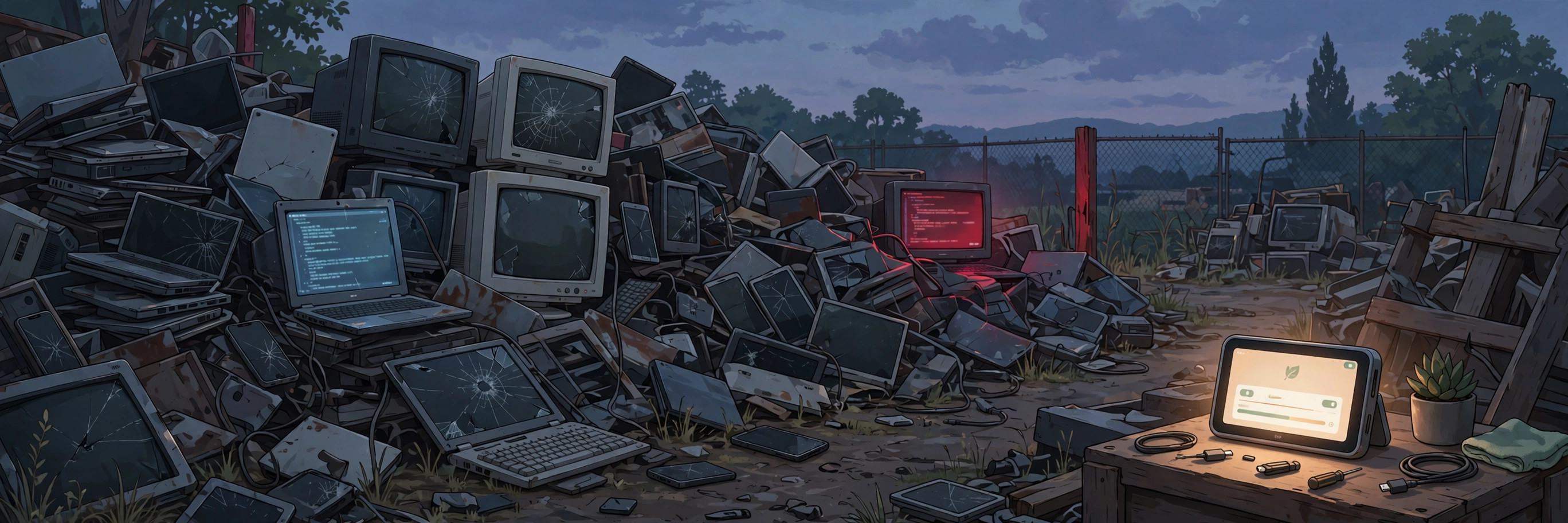
Drive through any corner of the open web right now and you will see it. Repositories with a burst of commits in a single weekend and nothing since. Apps announced with a launch post and abandoned before the first bug report. Landing pages for tools that no longer load. A junkyard of vibe-coded software, built fast, shown off once, and left to rust.
We say this as people who are glad the junkyard exists, in one specific sense. The reason there is so much abandoned software is that building software got dramatically easier. AI tools put working code within reach of people who could never have written it alone. That is a real gain. More people able to make the thing they imagine is good for the web, good for business, and good for the people who build. Nothing in this piece argues for putting the barrier back.
But a junkyard is still a junkyard, and it is worth being honest about how it fills up.
Starting got cheap. Finishing did not.
AI collapsed the cost of the first version. A prompt, an afternoon, and you have something that runs, something you can screenshot, something you can ship. What did not get cheaper is everything after that. Maintenance. Security patches. Dependency updates. Answering the issue from the one user who actually depends on the thing. Those costs are the same as they ever were, and they are paid in attention over months and years, not in one inspired weekend.
So the pattern repeats. The build is exciting and the upkeep is not, and the project joins the pile. Multiply that by everyone who now can build, and the pile grows fast.
Abandoned is not the same as harmless
A private experiment in a drawer harms no one. The junkyard problem starts when the experiment is published. A public repository makes promises whether its author meant it to or not. Someone finds it, builds on it, deploys it. Then the dependencies age out. A vulnerability is disclosed and never patched. An API key sits in an old commit. A service people wired into their workflow quietly stops working, or worse, keeps working in ways nobody has checked in a year.
None of that requires bad intent. It only requires a builder who left. Software that other people can reach carries responsibility, and walking away does not transfer it. It just leaves it unmet.
If AI built it with you, you still own it
Here is the principle we work by: generation is co-creation and publication is ownership. It does not matter how much of the code an AI wrote. The name on the repository, the domain, the release, is the name that answers for it.
That sets a simple bar. Before we publish something, we should be able to say yes to a short list of questions. Can we explain what it does and how? Can we fix it when it breaks, or find the break at all? Can we keep its dependencies current? Can we shut it down cleanly and tell people, if it comes to that? If the honest answer is no, the project is not finished. It was generated, and there is a difference.
Finishing is a discipline, not a mood
The fix is not fewer builders. The fix is builders who treat finishing as part of the work.
That looks like ordinary, unglamorous habits. Publish fewer things and carry each one further. Say the status out loud in the README: experimental, maintained, archived. A clear "unmaintained" is a responsible act; it lets the next person decide with open eyes. Put a license on it so others can legally pick it up if you put it down. When you are done with a project, close it properly instead of letting it fade: archive the repo, note why, point to alternatives if there are any.
All of it is what separates a body of work from a pile of starts.
The craft moved. It did not disappear.
When anyone can generate software, the scarce skill is no longer typing the code. It is judgment. Choosing what is worth building. Knowing what "done" means. Staying with a thing after the excitement of the first version is gone, because people are relying on it now.
We build as engineers and architects alongside AI every day, and we expect to keep building more, not less, because of it. That said, we will be intentional and responsible about what we build and publish to the public. We will maintain AGGREGATE long-term because we use it and we believe in it. Any other open source project we publish will be thoughtfully selected and maintained long-term. The tools are not the problem. The junkyard is what happens when the ease of starting convinces us that starting was the whole job.
Build anything. Then own it.
AI transparency: This article was originally conceived by the human author, drafted by AI, and edited and revised by the human author.